


Innovative techniques used in high-rise building repairs include drone-assisted diagnostics, robotic maintenance systems, advanced 3D printing for on-site component fabrication, and specialized rope access UK services that allow technicians to reach areas that are otherwise out of reach. As modern skylines continue to grow taller, the methods used to maintain these buildings have moved from basic scaffolding to high-tech, data-driven solutions.
These new methods aim to deal with the specific structural demands of tall buildings while keeping both workers and the public safe.
Beyond simple looks and cleaning, today’s repair strategies make use of advanced engineering tools like tuned liquid dampers and carbon-fiber hoisting systems. With Artificial Intelligence (AI) and the Internet of Things (IoT), building managers can now move from a reactive “break-fix” model to predictive maintenance. This forward-planning approach keeps a skyscraper’s integrity-from its high-performance glass façade to its main structural frame-intact, while causing as little disruption as possible to the city around it.
Why High-Rise Structures Require Specialized Repair Techniques
Maintaining a skyscraper is very different from working on a low-rise commercial building. The main reasons are the size and the strong environmental forces involved. High-rise buildings, especially very thin “pencil towers” with a slenderness ratio of more than 10 to 1, face large wind loads and possible seismic activity.
This movement, called the serviceability limit state in engineering, can cause cracked tiles, broken windows, and faster structural wear if it is not handled correctly. Standard repair methods are not enough to deal with the changing loads found hundreds of meters above ground.
Also, the complicated design of modern building exteriors-often using delicate materials such as metal cladding, composite panels, and triple-glazed glass-requires careful, accurate work. Traditional access methods are often too risky or simply cannot be used on irregular façades or buildings with many balconies and projections. Special techniques are needed to work on these detailed designs without harming the building’s appearance or its structural strength.
Which Innovative Techniques Are Used in High-Rise Building Repairs?
Drone-Assisted Inspection and Maintenance
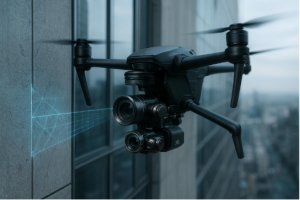
Drones have changed the early stages of high-rise repair by providing aerial views that previously needed costly helicopter flights or dangerous manual climbs. With LiDAR sensors and AI-based image analysis, drones can automatically spot structural faults, fine cracks in concrete, and thermal leaks in the building envelope. This high level of accuracy means repair teams know exactly where to work before anyone leaves the ground.
Some advanced drones are also being tested for light maintenance work. They can deliver small materials to difficult areas or spray protective coatings on façades. This cuts down the time human workers spend at high altitude in risky positions and makes the planning and handling of large repair projects faster.
Robotic and Automated Repair Systems
Robotic automation is becoming more common on construction and repair sites. Robots now handle repetitive or dangerous tasks such as precision welding, painting, and even bricklaying. These brick-laying robots and welding machines provide consistent results and reduce human error, helping repairs meet strict safety standards at height.
Alongside fully automated units, robotic exoskeletons are being used to help human workers. These wearable devices support lifting and carrying, reducing strain during long shifts. This boosts productivity and also supports workers’ long-term health, making especially demanding construction tasks a bit more manageable.
Advanced Rope Access and Abseiling Methods
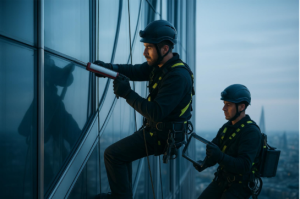
When machines cannot reach tight corners or complex shapes on a façade, advanced rope access is often the best option. Unlike large scaffolding, rope access systems take up little space and can be set up quickly. Technicians use strong, lightweight ropes to descend from the roof and carry out detailed repairs, glass replacement, and structural cleaning with high accuracy.
This approach works especially well for modern skyscrapers with curved lines or recessed sections. Because it does not require heavy ground equipment, it does not block roads or pavements, making it a popular choice for building managers in busy cities such as London or New York.
Building Maintenance Units (BMUs) with Smart Controls
Modern Building Maintenance Units (BMUs) have developed into advanced motorized systems. Instead of simple platforms, today’s BMUs often use telescopic and luffing jibs that can reach around corners, over ledges, and into recessed windows. Many are fitted with radio controls for accurate movement, reducing the physical effort needed from the crew.
For very tall buildings, multilayer drum hoists allow BMUs to work safely at heights of up to about 500 meters. These systems are often planned as part of the original building design so the roof structure can safely support them, offering a long-term, dependable method for ongoing maintenance.
3D Printing for On-site Repairs
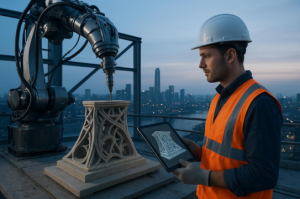
3D printing, also called additive manufacturing, is changing how replacement parts are produced. Instead of waiting weeks for a custom element to be made off-site and shipped, engineers can use on-site concrete and polymer printers to create precise components. This is especially helpful for restoring decorative details on historic towers or replacing unique brackets and supports.
On-site printing cuts material waste and speeds up repair work. It lets architects and engineers use unusual shapes or custom parts for retrofits, with far fewer limits on what can be built.
Modular Prefabricated Component Replacement
The “Lego-style” idea of modular construction is now used for repairs as well. When part of a high-rise is damaged, engineers can replace full sections of a floor or façade with prefabricated modules made in a factory setting. This method gained attention in projects like the T30 building in China, where pre-made parts allowed very fast construction.
Modular replacement gives better quality control and produces less dust and noise on-site. Because the modules are built to fit exactly, this plug-in style of repair shortens the time the building is open to weather and other external damage.
Non-Destructive Testing and Digital Diagnostics
Non-destructive testing (NDT) lets engineers inspect structural elements without cutting into them. Methods like ultrasonic testing and radiographic imaging can reveal internal corrosion in steel reinforcement or voids inside high-strength concrete. This is especially important for the main load-bearing parts of the building.
These tests are often used alongside Building Information Modeling (BIM). A digital twin of the skyscraper is kept up to date, so managers can model how each repair will affect the rest of the structure. This data-based method helps make sure every repair step is necessary and effective.
Smart Glass Technology for Sustainable Façade Upgrades
Façade repairs are often a good time to upgrade performance. Smart glass can change its tint or opacity based on sunlight levels, cutting heat gain and lowering energy use for air conditioning. Some smart glass also contains photovoltaic cells, turning the building’s exterior into a vertical power source.
During repairs, swapping standard glass for smart glass or double-skin façades improves the building’s environmental performance. These newer materials are usually more durable and offer better insulation, supporting the long-term efficiency of the high-rise.
How Do These Innovative Techniques Improve Repair Outcomes?
Increases Efficiency and Reduces Downtime
Time directly affects income in commercial real estate. Techniques like modular replacement and drone inspection can cut months from repair schedules. By dealing with likely problems before work starts—through digital twins and pre-made parts—contractors can keep the building in use and avoid expensive shutdowns of offices, data centers, and other critical spaces.
Specialized access methods, such as those detailed at https://www.ropeaccessinlondon.co.uk/, also reduce the number of workers needed on-site at any one time. This makes planning easier and allows maintenance to be scheduled in ways that cause the least disruption for people using the building.
Improves Contractor and Public Safety
Safety is the main benefit of these new methods. High-rise construction and repair are among the most hazardous areas of work. Using drones for inspection and robots for risky tasks at height lowers the amount of time people are exposed to high winds, falls, or other dangers.
Special systems like tuned mass dampers and seismic isolators (for example, Mega Truss systems) also help keep the building steady during repair work. This protects both the structure and everyone inside or near the tower.
Enhances Precision and Quality of Repairs
Human error is always a factor in manual repair work. In contrast, 3D printing and robotic welding can reach levels of accuracy that people cannot match by hand. These tools help make sure every joint, weld, and panel is correctly positioned, which is important for the building’s wind performance and long-term stability.
Using advanced materials such as Carbon Fiber Reinforced Polymers (CFRP) for strengthening work also increases the load capacity of existing structures. These materials are light, strong, and resistant to corrosion, often giving a repair that outperforms the original construction.
Supports Sustainable and Energy-Efficient Solutions
Modern repair approaches place strong focus on environmental impact. Off-site prefabrication can produce under 1% of the waste from traditional site-built methods. Adding green features such as vertical gardens and high-performance façades during repair work can lower a building’s carbon footprint and reduce local heat build-up in dense city areas.
Energy-producing features, such as building-integrated wind turbines or solar-active glass, let skyscrapers produce some of their own power. This shift from simply reducing harm to actively providing environmental benefits reflects current engineering goals.
What Are the Risks and Considerations of Using Advanced Repair Methods?
Technical Limitations and Equipment Costs
Despite the clear benefits, the initial cost of advanced technology can be a major obstacle. Robotic systems, high-spec drones, and specialized BMUs need large capital investment. Some systems, like tuned liquid dampers, must also be customized for each building, so there is no general, standard solution.
There are also technical limits. For example, sloshing dampers can behave in a non-linear way, meaning their performance changes with the size of the building’s movement. Engineers must carefully weigh these technical issues against the project budget.
| Challenge | Impact |
| High equipment cost | Raises upfront capital needs |
| Custom design per building | Longer design and approval times |
| Non-linear damper behavior | More complex analysis and tuning |
Training Requirements for Specialized Personnel
High-tech tools depend on skilled operators. There is a growing shortage of workers trained to run AI-based diagnostics, manage drone fleets, and operate robotic repair units. These specialists need detailed training to carry out complex tasks safely and to meet modern safety rules.
This need for expert labor can increase the total cost of a project. However, investing in specialist skills usually pays off through better-quality work and fewer accidents or delays.
Building Regulations and Compliance Concerns
High-rise repairs must follow many local and international rules, such as OSHA, CCOHS, and TSSA standards. New tools like 3D-printed structural parts or autonomous robots often fall into areas where laws and codes are still catching up with technology.
Structural engineers should be involved early in planning to check that any new access system or repair method matches the building’s structural limits and installation needs. This helps keep the building safe and compliant throughout its life.
What Role Does Technology Play in the Future of High-Rise Repairs?
Integration of AI and Predictive Maintenance
The future of high-rise repair is moving toward the “smart skyscraper.” With AI connected to a network of IoT sensors, buildings will be able to react to incoming storms by adjusting dampers or securing façades automatically. AI can forecast when a part is likely to fail, allowing repairs to happen just before a small fault becomes a large structural problem.
This shift turns the building from a passive structure into an active system. It supports occupant comfort while sharply reducing wasted materials, time, and energy.
Data-Driven Decision Making for Lifecycle Management
Building Information Modeling (BIM) will continue to act as a digital record and planning tool for skyscrapers. By keeping a live digital twin, building managers can make choices based on long-term data trends. This helps with budgeting, scheduling, and understanding how the building is aging over time.
Augmented Reality (AR) will also help by giving field technicians real-time visual guidance during complex work. Remote experts can support teams on-site through AR, lowering the need for multiple visits and speeding up problem-solving.
Sustainability and the Move toward Green Repairs
As construction focuses more on climate impact, repairs will increasingly use materials like mass timber and carbon-injected concrete. These materials can store carbon instead of releasing it, helping buildings act as carbon sinks. The goal will be to create strong, resilient vertical communities that can handle changing climate conditions.
Water recycling systems and living façades that filter city air are likely to become normal in high-rise retrofits. Future skyscrapers may act like living systems that support local plant and animal life and serve as visible examples of responsible design.
Key Takeaways for Building Owners and Managers
Selecting the Right Innovative Repair Method
Choosing the right repair method depends on the building’s height, use, and façade design. A BMU may suit a tall glass tower, while rope access might be more affordable and flexible for a building with many ledges and recesses. Owners should work with specialist consultants who can match solutions to architectural needs, maintenance goals, and safety requirements within the available budget.
The use of the building also matters. Residential towers usually have stricter comfort limits for acceleration (about 15-18 milli-gs) than office buildings (about 20-25 milli-gs). The selected repair or damping system must match these serviceability targets.
Working with Qualified Contractors and Providers
Because high-rise systems are complex, choosing experienced partners is essential. Companies with long experience in vertical access and structural engineering have the knowledge to deal with technical and regulatory challenges. They can offer custom solutions-from liquid dampers to integrated design and access planning-that support long-lasting maintenance results.
Qualified contractors will also put strong focus on worker and public safety, using modern PPE, planning tools, and tracking systems for each stage of the project. This level of management reduces liability and helps keep the repair process smooth and predictable.
Embracing Technology for Long-Term Value
While new technology can be costly at the start, it tends to provide strong long-term value. Predictive maintenance and advanced materials extend a building’s life and protect its market appeal. By investing in smart systems now, owners can keep their properties competitive and efficient for many years.
Ultimately, the aim of high-rise repair is to keep these tall symbols of human progress safe, stable, and efficient. By making smart use of innovation, building managers can turn what might seem like a challenging maintenance problem into a chance to improve performance, cut waste, and support environmental goals. Whether using a robotic arm or a skilled technician on a rope, the future of our skylines depends on careful, intelligent repair methods.
