

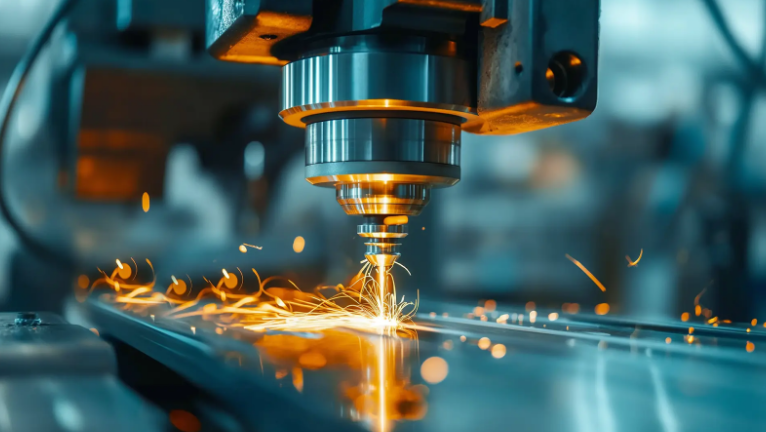
CNC (Computer Numerical Control) has completely transformed the manufacturing industry, substituting conventional manufacturing approaches with computerised accuracy that fits contemporary market requirements. To B2B companies CNC machining provides incredibly high precision, productivity, and flexibility, and is essential for such industries as aerospace, automotive, and medical. In this article, the author discusses the development of CNC machining ; its accomplishments, and its significance in the field of progressive manufacturing.
Conventional Turning Techniques
Prior to the incorporation of CNC machining, a lot of manufacturing techniques relied on utilization of hands and took a lot of time besides needed skilled personnel. The old machining was categorized using simple applications of cutting tools such as lathes, mills, and drills in the company with a machinist manually operating the tool.
Challenges of Traditional Machining:
– Limited precision: Manual processes were very often inaccurate and had led to inconsistency in parts being produced.
– Time-intensive production: On the parts that were very many, it was very time consuming to set up and operate, and thus the slow production process.
– Skill dependency: Control of the output quality remained central to the machinist’s proficiency.
However, these methods formed the basis of the current manufacturing techniques; nevertheless, the restrictions of conventional machining necessitated advanced and accurate approaches.
Birth of CNC Technology
Computational changes in the manufacturing industry started in the middle of the century when NC, short for numerical control, was invented. These systems employed the use of punch cards and primitive programming for the establishment of machining. This was the infancy of a new generation of manufacturing, for NC systems significantly increased the level of accuracy to performance and decreased the amount of interference from the operators.
Key Milestones in CNC Development:
– 1960s: The arrival of Computer Numerical Control (CNC), a technology in which computers substituted the control punched cards for the programming of machines.
– 1980s: Technological advancement specifically of CAD and CAM systems to translate designs produced on a computer to the computer readable instructions.
– 1990s: Larger capacity and accessibility of all multi axis machining, that permit design and generation of parts with complex shape and geometry.
At this period, CNC technology was revolutionized as the key technology for industries with high demands on precision and scalability. A contemporary CIM firm like a CNC milling could for instance develop extremely complex workpieces that offered a precision that could not be vouchsafed using conventional machining processes.
Modern CNC Machining Capabilities
Modern CNC machining is an increasingly complex process enhanced by modern software and ultra-modern equipment. Present day computer numerical control can complete basic as well as highly flexible operations with a lot of precision, speed and effectiveness.
Key Features of Modern CNC Machining:
– High-precision machining: Today’s versions of such technology can even display tolerated accuracies of microns and thus are well suited for industries that are highly specific.
– Multi-axis machining: A 5-axis or 7-axis machine is capable of producing intricate shapes for the intended part in one operation thereby increasing efficiency.
– Automation and robotics: Compatibility with robotic systems otherwise means the company can operate twenty–four/ seven, enhancing on its production line while respecting frequent power blackouts.
– Smart manufacturing: Today’s CNC systems include the IoT (Internet of Things) and are designed for real-time condition monitoring and predictive maintenance.
Such developments render CNC machining as the ultimate remedy to companies in search of sophisticated machining technologies for their manufacturing requirements. If it is aerospace parts manufacturing or development of medical equipment, CNC technology guarantees versatility and precision.
Advantages for B2B Manufacturing
To the B2B organizations out there, CNC machining offers numerous benefits that are hard to come by with conventional techniques. In large-scale contexts, its ability to offer reliable and high-quality outcomes makes the solution favorable for use in automotive, aerospace, and industrial machinery markets especially.
Key Advantages of CNC Machining:
– Efficiency: Both types of applications also decrease the time to produce goods and increase the output consistent with the time constraints that manufacturers sometimes have.
– Scalability: The CNC systems are highly flexible to a volume of production that means it can be used in small-scale production and large-scale production.
– Cost savings: The expenses incurred in purchasing new CNC equipment may be large sometimes, but in the end, it is cheaper than having to constantly pay employees large sums to repeat the same task over and over as well as wasting raw material.
– Design flexibility: There are many advanced software solutions that enable the manufacturers to develop complicated designs compared to traditional techniques.
– Consistency: By using computer numerical control in making of the products, it is made very clear that product quality is of big importance and there are usually high standards of work throughout production runs.
More particularly, industries that call for timely and accurately produced complex parts retain the benefits of CNC machining technology.
The Future of CNC Machining
It might be a long way for CNC machining to go, but its evolution has just begun. However, as the industry grows, improved and more complex solutions are being developed using artificial intelligence, as well as machine learning, and improving sustainability. These innovations are being placed on the path of defining the future of manufacturing and presents a wholesale interest for businesses across the globe.
Emerging Trends in CNC Machining:
– AI-powered systems: It has been noted that AI is being employed in enhancing the machining procedures and minimizing wastage.
– Additive manufacturing integration: Currently, the CNC systems are being integrated with the 3D printing technologies, making them to form a single compound system.
– Sustainability initiatives: Improving environmental-consciousness in machining through energy efficient machines and reduced material consumption is still on the agenda of B2B manufacturers.
– Digital twins: Digital twins enable manufacturers to model machining processes virtually before physical implementation thus cutting on costs due to the many mistakes encountered in real manufacturing.
CNC milling firms or other B2B manufacturing companies must ensure they follow the following trends for them to remain competitive in the global marketplace.
Traditional and radical machining methods explain how far the manufacturing technology has evolved as well as introducing new high-tech precision CNC systems. For B2B manufacturers, this invention brought a new level of improvement through efficiency and accuracy that can fulfill the current market challenges.
With embracing state of the art advanced machining solutions and numerous technologies in the future, CNC machining will still be the strong pillar of manufacturing around the world. Navigating through the possibilities of better production or the search for a trustworthy CNC milling company is only possible if the overall concept of CNC machining is clear and its development assessed for the long term.
