

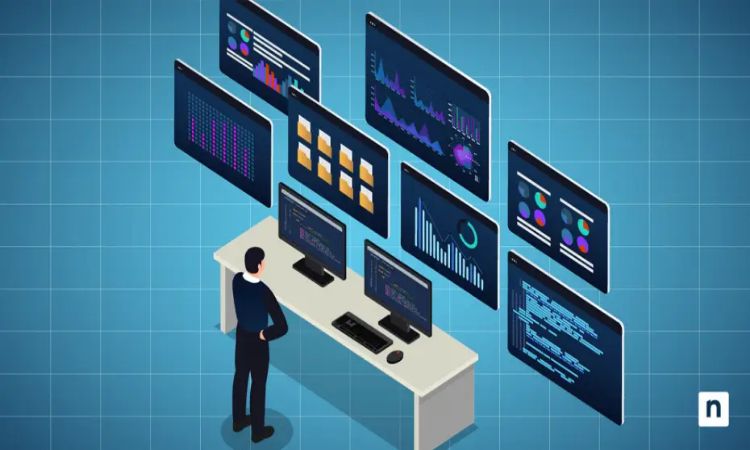
Monitoring of IT systems mainly seeks answers to two core questions: what is happening and the reason for that development. IT observability is the soul of business sustainability, as it detects problems, progress, and troubleshooting using the seamless real-time data that unfolds.
In official terms, monitoring has been called a process of collecting, processing, aggregating, and capturing real-time data covering query counts, error counts, processing times, and many variables such as server lifetimes.
Among the various types of system monitoring, there are infrastructure monitoring, network monitoring, application performance monitoring (APM), multi-cloud monitoring, data monitoring, synthetic monitoring, real-user monitoring (RUM), and security monitoring.
Important for client-based businesses
Continuous monitoring is important in client-based services where services have to be operated as per agreed performance levels. Monitoring tools determine the efficacy of processes in an organization’s IT equipment and digital infrastructure and see how strong it is to deliver the services effectively.
From a developer’s perspective, observability tools are a prerequisite to improve delivery, performance, and customer experience of the applications they create. That is why a microservices architecture is in place that enables the deployment of applications across distributed environments. It helps in faster development of applications to deliver and scale up. However, tracking a distributed environment poses many challenges.
This calls for a centralized module for both organizations and developers or IT observability to aggregate data from a distributed environment. The tool must monitor different infrastructure panels that support delivery and be good enough to resolve issues before they snowball into serious concerns.
ITSM tools for monitoring
There are excellent tools with ITSM (IT Service Management) solutions for system monitoring, offering optimum visibility into the health and performance of IT infrastructure and applications. IT observability helps organizations to spot and solve issues and strengthen smooth service delivery.
Some of the popular ITSM modules with robust monitoring capabilities include Jira Service Management, Freshservice, ServiceNow, and SolarWinds Service Desk, among others.
The success of system monitoring is a spillover of the well-integrated IT service management (ITSM) architecture that maintains best practices in incident management, information security management, configuration management, problem management, capacity and performance management, service deployment management, and change enablement.
System monitoring with IT Service Management (ITSM) observability tools also enables enhanced collaboration and real-time data analysis. This empowers IT teams to manage system performance, identify failure points, and strengthen system reliability to reach zero downtime. Looking for solutions like these? Check out companies like Opentext.
Monitoring tools for developers
Developers want consistent system monitoring for drawing valuable insights into system performance, detecting potential issues, and framing faster responses to critical problems, improving user experience and system reliability.
Continuous monitoring allows developers to identify performance bottlenecks and issues that impact users and can address them before they escalate.
There are best solutions with vendors like Open Text Corporation with its portfolio of ITSM custom products.
The monitoring dashboards provide a centralized view of the system to assess the system’s health for collaboration and communication between development, operations, and security teams.
Benefits from customer focus
The IT observability tools are a bonanza for developers to address performance bottlenecks and perform efficient application execution. Monitoring data will identify problems, and they can plan debugging and detailed analysis.
ITSM, with its focus on managing IT systems with a customer perspective in contrast to technology-heavy approaches in IT management, aims to add value to the business with faster turnaround times and customer happiness.
In short, IT observability and effective system monitoring ensure the quality of services are being provided with a higher customer orientation. ITSM, with its models and benchmarks of best practices, auto-corrects any internal flaws in delivery, ushering in a high-growth scenario for the business.
