

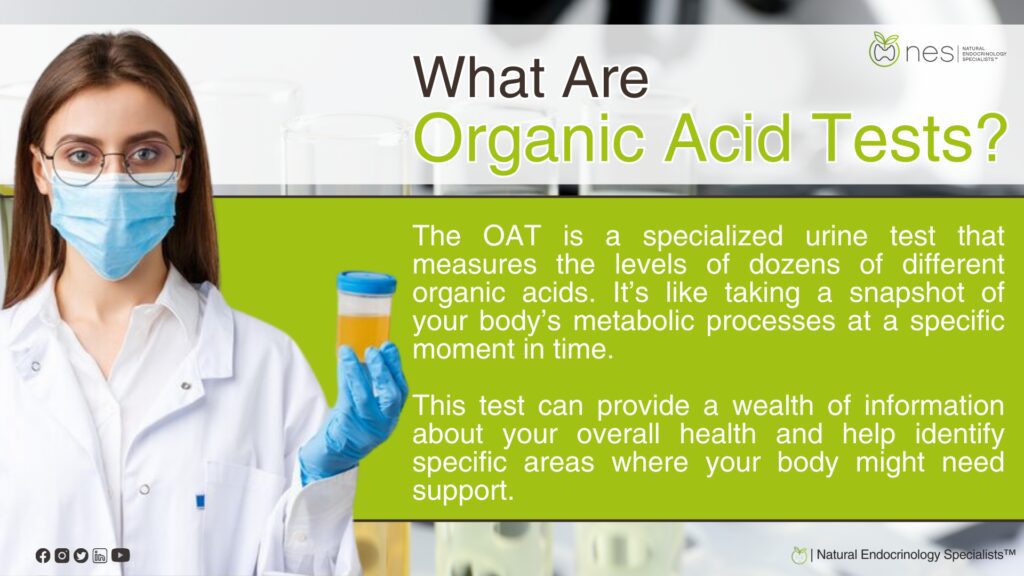
You can feel “off” long before a diagnosis appears. At times, it is low energy, brain fog, mood shifts or poor recovery. Often, standard blood tests may still look normal. This is where the organic acid test helps.
The organic acid test (OAT) is a laboratory analysis that measures a variety of small metabolic by-products (organic acids) excreted in urine. These compounds are naturally produced as the body metabolises carbohydrates, fats, proteins, and other biochemical pathways. Their levels in urine can reflect how well key metabolic systems are functioning.
In clinical practice, urine organic acid analysis has long been used to detect inherited metabolic disorders (e.g., organic acidemias). It is typically performed using gas chromatography–mass spectrometry (GC–MS), or increasingly, liquid-chromatography mass spectrometry (LC–MS) methods. These offer high analytical sensitivity and specificity.
Why Organic Acids Matter
Every second, your cells are running chemical reactions for
- Energy production
- Neurotransmitter balance
- Detoxification
- Fat metabolism
- Protein breakdown
Organic acids are the footprints of those reactions. By measuring them in urine, clinicians can see patterns.
How Organic Acid Levels Relate to Metabolism
As discussed, organic acids are intermediate products of many metabolic pathways:
- Energy production pathways, such as the citric acid (TCA) cycle that generate cellular energy (ATP)
- Amino acid metabolism: breakdown products from protein metabolism
- Fat metabolism: organic acids produced during fatty acid oxidation
- Neurotransmitter “turnover”: metabolites of dopamine, serotonin and other signalling chemicals
- Microbial metabolism: by-products formed by gut microorganisms
Because organic acids are downstream products of these processes, their patterns can provide a snapshot of biochemical activity and pathway function.
What an Organic Acid Urine Test Measures
A broad organic acid profile may measure dozens of markers. Also, each can be linked to different aspects of metabolism like:
1. Cellular Energy and Mitochondrial Function
Markers such as citrate, succinate, and malate are intermediates in energy-generating pathways. Variations in their levels may suggest alterations in mitochondrial energy production.
2. Nutrient Status
Certain organic acids are associated with the metabolism of vitamins and cofactors. For example:
- Methylmalonic acid is elevated in vitamin B12 deficiency
- Some metabolites reflect vitamin B6 and folate-dependent pathways
3. Neurotransmitter Metabolism
Compounds such as homovanillic acid (HVA) and vanillylmandelic acid (VMA) arise from dopamine and epinephrine metabolism, respectively, and are included in many test panels.
4. Microbial Metabolites
Certain acids arise from gut microbial activity, though their interpretation must be cautious (see “Limitations” below).
What Science Shows
Organic acid testing is part of a scientific field called metabolomics.
Metabolomics studies small molecules in biological samples to understand physiology and disease processes. Urine is particularly useful because it reflects systemic metabolic activity and is easy to collect.
Studies in healthy adults show that organic acid patterns vary based on diet, lifestyle, genetics, and environmental exposure.
Limitations and Considerations
Such tests are not replacements for conventional blood work. They do not diagnose chronic fatigue, anxiety, or hormonal disorders.
Results must be interpreted alongside:
- Clinical history
- Physical examination
- Standard laboratory testing
- Lifestyle factors
What Organic Acid Testing Can Tell Us in Practice
Although much of the research focus has historically been on inherited metabolic diseases, organic acid analysis also has emerging applications in broader metabolic research and clinical investigation:
Functional Insight Into Metabolism
Patterns of organic acids may offer clues about how well biochemical pathways are functioning, especially pathways linked to energy production and nutrient metabolism.
Evaluation of Nutrient Metabolism
Organic acid profiles can help indicate functional insufficiencies in nutrient-dependent pathways that may not always be apparent with standard blood nutrient levels.
Metabolomics Research
Urinary organic acids are increasingly used in metabolomics studies to explore connections between metabolism and health outcomes, building towards better understanding of disease mechanisms.
Who Might Benefit From Deeper Metabolic Assessment?
Individuals who experience:
- Persistent fatigue despite normal labs
- Brain fog or reduced mental clarity
- Digestive disturbances
- Mood variability
- Difficulty recovering from stress
In these cases, looking at metabolic intermediates may provide additional insight.
Summary: Where OAT Fits in Metabolic Assessment
The organic acid test is a biochemical profiling tool. It reflects the activity of multiple metabolic processes. It relies on advanced analytical techniques and can provide rich data about metabolic pathway activity, nutrient-dependent reactions and intermediary metabolite patterns.
In clinical settings, it has a firmly established role in detecting inherited metabolic disorders. In broader health assessment, it serves as a window into metabolic function, supporting research and, with careful interpretation, offering insights into nutrient use and biochemical balance.
In simpler words, the organic acid test offers a window into biochemical pathways. It does not replace diagnosis. It adds depth. And sometimes, depth is what moves the conversation forward.
